In Pakistan, a video of six people singing and dancing went viral. Seven murders followed
A village council in Khyber Pakhtunkhwa decided that the men and women should be killed because they had hurt the tribe’s honour.
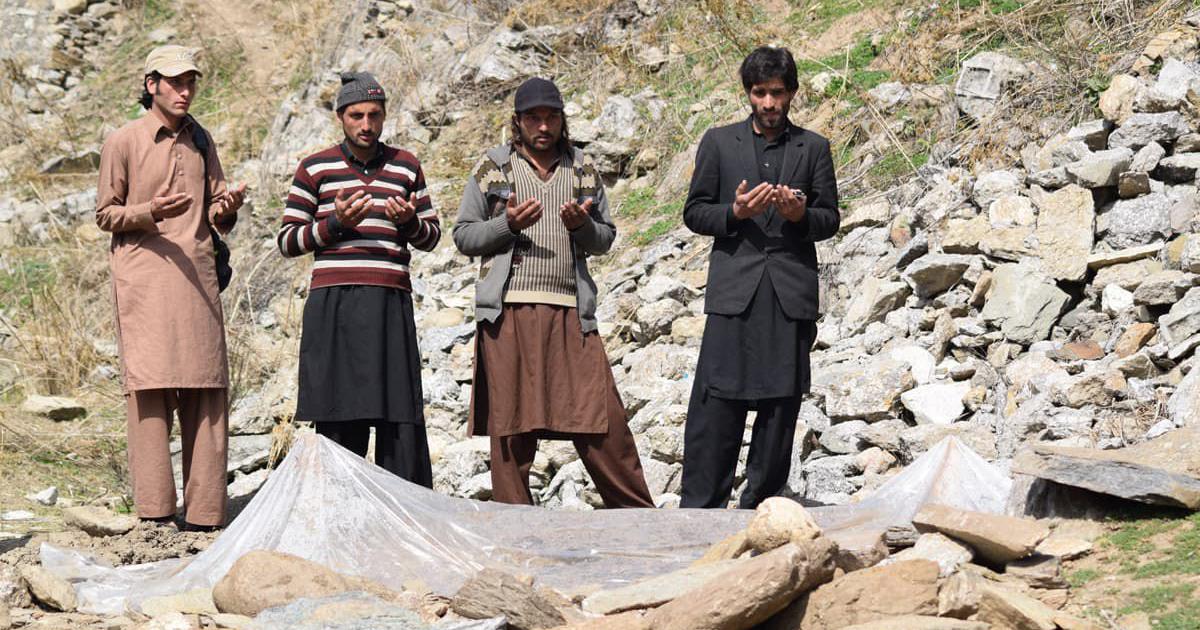
“All our lives we have lived in purdah. Now that we have finally met, your locks look so beautiful,” sang four young women, sitting in a room on the bare floor, draped in dark shawls. It is a song in Kohistani, a language spoken in Pakistan’s Khyber Pakhtunkhwa province. The women clapped along. Away from them, a young man with bangs danced.
A video clip featuring the five started doing the rounds in May 2012. Since then, three of the four women and four brothers of the dancing man have been killed. One of the brothers, Muhammad Afzal, was murdered on March 6.
That evening, Afzal was sitting inside a passenger van in Abbottabad city’s garrison area. According to his nephew, Faizur Rehman, who was accompanying him, an armed man, Abdul Hameed, appeared there along with two others, Mosam Khan and Bazameer, and opened fire at Afzal. Hit by several bullets, he died on his way to a hospital.
Doubts on a killing
The incident took place near a police station. A policeman posted there says he rushed to the site of the gunfire – a nearby van terminal – as soon as he heard about it. When he reached there, he saw a young man trying to escape. The policeman followed him and caught hold of him. He was carrying a loaded handgun and a spare magazine with 10 bullets in it. His name, Faizur Rehman. The gun he was carrying was licensed under the name of his uncle, Afzal, who carried it along all the time.
Police officials in Abbottabad say Rehman has changed his statement about the incident several times. If there were any assailants as he claims and one of them did fire at Afzal as he describes, the police ask, how did Rehman escape the bullets given that he was sitting closer to the rear opening of the van than his uncle – thus, being more vulnerable to firing from outside.

They are also sceptical of Rehman’s claim that he pulled out the gun from a holster tied to Afzal’s waist to fire back at the attackers. If so, they ask, how did he find time amid all the emergency caused by the attack to lay his hands on the additional magazine?
The police claim to have an eyewitness, Kaleemullah, a tribesman from Bajaur tribal district, to corroborate their version. Kaleemullah saw a roadside vendor – who also came from Bajaur – being hit by a bullet that had gone through Afzal’s body. When Kaleemullah rushed to help the injured vendor, he saw Rehman with the gun which he thought was the source of the bullet that had hit the vendor. Kaleemullah tried to grab Rehman and was fired at from the same gun. He ran away to save his life, he claims, but Rehman chased him and shot him on the second floor of a nearby cloth store.
A forensic report also states the bullets found in Afzal’s body and the one that injured Kaleemullah were both fired from the same pistol recovered from Rehman. The police have arrested him and lodged a case against him for the murder of his own uncle.
Dr Farzana Bari, an Islamabad-based academic and women’s rights activist, who has been following the whole video clip saga since its beginning, says Afzal came to her house to condole the death of a niece of hers only two days before he was murdered. “His nephew, Faizur Rehman, was with him,” she says and wonders why he would kill Afzal in a public place while the two stayed in each other’s company all the time.
The police have also arrested Mosam Khan, one of the two people accompanying Afzal’s attacker. He has been kept in detention for investigation for several weeks now though no case has been filed against him.

The Afzal, who was
Afzal once lived and worked in Mansehra city, in the northeastern Khyber Pakhtunkhwa province. He was married to a girl he loved. She came from a background completely different from his own.
Afzal was a Kohistani tribesman, born and brought up in a mountainous village in the Kolai-Palas region (which was made a district in 2017 after separating it from Kohistan district). His wife was a city dweller who belonged to a Hindko-speaking family of Abbottabad city.
Afzal was quite enterprising. At various stages in his life, he ran a tailoring shop, worked as a clerk with a lawyer, sold tickets for government-run buses that connect the Gilgit-Baltistan region with the rest of Pakistan, and even traded bee honey. He also studied law in his spare time. Two of his younger brothers – Gul Nazar, a college student, and Bin Yasir, a manual labourer – also lived with him.
Their father, Narang, had a big family – seven sons and a daughter. Narang belonged to a tribe called Salehkhel and lived in Gadaar village along Karakoram Highway some 160 km north from Mansehra. The village had only three other families that came from the same tribe as Narang’s. The members of another tribe, Azadkhel, comprised 75% of the local population of around 200 households. The rest belonged to two smaller tribes.
Before he died about 20 years ago, Narang worked as a tailor. He also owned a small patch of land in Gadaar where his sons worked hard and produced over 20,000 kilogrammes of corn every year. His large family lived comfortably, if not luxuriously.
His sons also enjoyed considerable respect among their fellow villagers. One of them would lead prayers at a local mosque. Life for his children was peaceful and decent.
The night that changed all
Sometime in 2010, Nazar and Yasir travelled from Mansehra to Gadaar to be with their family. One night during their visit, four women from Gasaar – Siran Jan, Begum Jan, Bazeegha and Amina, all from Azadkhel tribe – came to their house. They sat down in a room along with the two boys and, after a brief conversation, started singing to the beat of their own clapping, “All our lives we have lived in purdah...”
One of the young men, Nazar, danced and the other, Yasir, recorded the singing, clapping and dancing, on a mobile phone. This is at least what the families of the young women alleg
Around two years later, the video clip surfaced on the internet. As it went viral, police officials at a local police station registered a case, alleging that “Bin Yasir and Gul Nazar called the women of Azadkhel caste to their dera where they made an obscene video of the women and made public the same.” Within days, the two brothers were arrested under the Motion Pictures Ordinance and held in custody for six and a half months.
Nazar and Yasir deny meeting the women. They say someone mixed a video clip of Nazar’s dance, made at an uncle’s wedding, with a video of women singing and clapping. Nobody takes their claim seriously.
On December 18, 2012, Nazar and Yasir were acquitted after a trial court found that the video was neither obscene nor disseminated by the two
The brothers immediately shifted to Lahore for their safety.
Two of their elder brothers, Afzal and Gul Shahzada (who worked as a tailor in a valley below his own village), had by then shifted to Allai, a former princely state, in Battagram district, halfway between Mansehra and Kolai-Palas. A powerful Allai landowner had offered them protection against any hostilities from the Azadkhel tribe. Nazar and Yasir, too, joined them there a few days later.
Three other Salehkhel families living in Gadaar also moved to Allai, leaving behind Narang’s three sons, their wives and children.
Nobody knew what happened to the women. Police in Kolai-Palas said an Azadkhel jirga (village council) assembled soon after the video clip emerged. The participants of the jirga ruled that those who appeared in the video were chor (thieves). They demanded, as is local custom in such cases, that the women in the video, the woman who took them to Narang’s house and the two young men were all liable to be killed since they had hurt the honour of the whole Azadkhel tribe.
An intervention
Afzal did not want these punishments to materialise. Soon after his brothers were taken into police custody, he started approaching journalists and human rights activists, alerting them that the lives of the women in the video were in danger. If anything, his efforts had a contrary effect: local people turned against him. They were incensed that he was disregarding tribal traditions that govern the interaction between men and women who are not related by blood. His demands for the protection of the women were seen as a transgression that brought dishonour to the whole Kohistan region and its conservative culture.

Within days, though, Afzal’s voice started resonating elsewh
On June 4, 2012, Iftikhar Muhammad Chaudhry, the then Chief Justice of Pakistan, took suo moto notice of reports that the women might have already been killed. He immediately directed Khyber Pakhtunkhwa police to find out what was going on in Gadaar.
A police report presented during the next hearing refuted what was already public knowledge in many parts of Kolai-Palas. They said that no jirga had been held over the video, let alone anyone having killed the women featuring in it. Justice Chaudhry asked police officials if they had met the women. They said they had not because the tribal tradition of purdah would not permit that.
As proceedings that day moved towards a close, Justice Chaudhry spotted Dr Bari, the Islamabad based activist in the audience at his court and told the police to take her to Gadaar to investigate the case again. He also directed Rehman Malik, the then federal interior minister who was also present in Court, to arrange a helicopter to fly Bari and police officials to the village.
Bari thought that she should take some others along with her. She contacted the National Commission on the Status for Women to recommend some names for the purpose. She received three names: Shabeena Ayaz (who works with Aurat Foundation, an Islamabad-based non-government organisation focused on women’s rights), Dr Fouzia Saeed (a researcher, writer and women’s rights activist) and Riffat Inam Butt (a National Commission on the Status for Women representative).
All three women agreed to accompany Bari. With their inclusion, what originally was to be a police probe became a fact-finding mission.
In pursuit of facts
When the members of the mission flew into the Kolai-Palas area, they could not go straight to Gadaar because the village, located on a high cliff, had no suitable place for a helicopter to land. They, instead, landed in Sartay, a village nestled in the valley below.

The residents of Gadaar had been informed about the visit but none of them arrived in Sartay to meet the mission. They were still in their village high up in the mountains. If the members of the mission wanted to meet the families of the women, they had to either climb up the mountains or wait for the villagers to climb down
Instead of waiting in Sartay, the members of the mission decided that they would climb halfway up and asked the villagers to climb halfway down. Everyone agreed.
The trek uphill was arduous so Saeed decided to stay back. The other women, too, had to use police batons for support to climb upwards. After an hour and a half, they reached a place where one of the women from the video, Amina, was present to see them. “We were informed that other women could not come down because they were too high up in the mountains,” said Bari.
The members of the mission told the Supreme Court during the next hearing that they could only meet one of the women from the video. The court then formed a judicial commission, to be headed by an additional district and sessions judge, Munira Abbasi, to probe further and submit its report in 10 days. The commission was to also include all the three women who had met Amina.


 Hello, my name is Jack Sparrow. I'm a 50 year old self-employed Pirate from the Caribbean.

0 comments: